

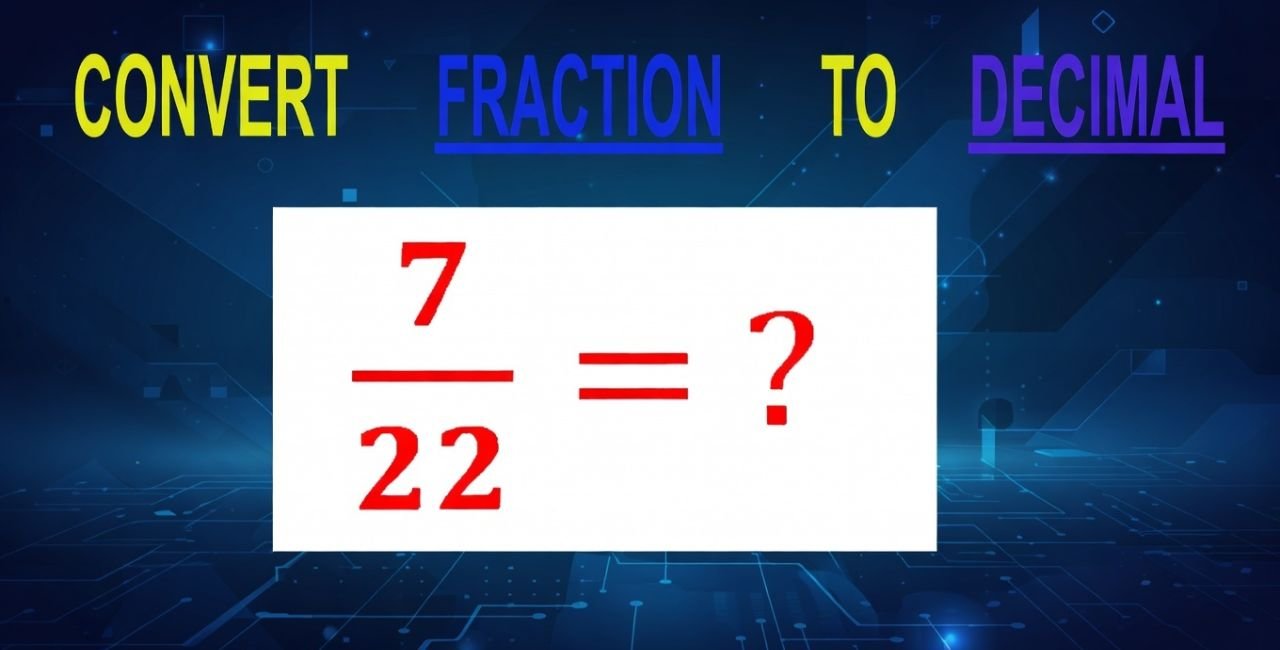
Have you ever wondered which is the decimal expansion of 7/22? This question pops up in math classes and homework. It tests your skills in turning fractions into decimals. In this article, you will find out the answer step by step. We will break it down so anyone can follow. You will see why the decimal repeats and how to spot patterns like this in other fractions. Let’s dive in and make sense of it all.
Understanding Fractions and Decimals
Fractions show parts of a whole. Think of a pizza cut into pieces. The number on top is the numerator. It tells how many pieces you have. The bottom number is the denominator. It shows how many pieces make the whole. For 7/22, you have 7 parts out of 22.
Decimals are another way to show the same idea. They use a point to separate whole numbers from parts. For example, 0.5 means half. Decimals can end, like 0.25 for 1/4. Or they can repeat, like 0.333… for 1/3.
Why do we need both? Fractions are exact. Decimals help with quick adds or measures. In real life, you see decimals in money or lengths. Knowing how to switch between them helps a lot.
People first used fractions long ago. Ancient folks in Egypt and Babylon split things with them. Decimals came later, around the 1500s in Europe. A man named Simon Stevin helped spread the idea. He wrote a book in 1585 that showed how decimals work.
Today, we use both in schools and jobs. Engineers use decimals for plans. Cooks use fractions for recipes. Learning to convert them builds your math base.
How to Convert a Fraction to a Decimal
You convert a fraction to a decimal by dividing. Take the top number and divide by the bottom. Use long division for this. It works every time.
Here are the steps in a list:
- Set up the division. Put the numerator inside the box. The denominator goes outside.
- Add a decimal point. If the numerator is smaller, add .0 to make it bigger.
- Divide step by step. Find how many times the denominator fits into parts of the numerator.
- Track remainders. If a remainder repeats, the decimal repeats.
This method always gives the right answer. Practice it with easy ones first, like 1/2 = 0.5.
Some fractions end in decimals. These have denominators with factors of 2 or 5 only. Like 1/4 = 0.25. Others repeat if the denominator has other primes.
For repeating ones, we use a bar over the repeating part. This saves space and shows the pattern.
Tools can help too. Calculators do the division fast. But doing it by hand teaches you more. Apps like those on laaster.co.uk offer practice problems.
Step-by-Step Calculation for 7/22
Now, let’s find which is the decimal expansion of 7/22. We will do the long division together.
Start with 7 divided by 22. 7 is smaller, so write 0. Then add a zero to make 70.
22 goes into 70 three times because 22 x 3 = 66. Subtract 66 from 70 to get 4.
Bring down a zero to make 40.
22 goes into 40 one time because 22 x 1 = 22. Subtract to get 18.
Bring down a zero to make 180.
22 goes into 180 eight times because 22 x 8 = 176. Subtract to get 4.
Now, 4 is back. This means the process repeats from here. So, the digits after the first 3 will be 18 over and over.
The decimal is 0.3181818… We write it as 0.3\overline{18}.
This matches what math experts say. For example, sites like Gauthmath explain it with similar steps.
Why does the remainder 4 come back? It’s because 22 and the remainders cycle in a loop. This happens with many fractions.
Let’s check with another way. Multiply 0.3181818… by 22. It should give about 7. Yes, it does.
Why Does the Decimal Repeat?
Repeating decimals happen when the division doesn’t end. The denominator has factors that don’t divide evenly into powers of 10.
For 22, it factors into 2 x 11. The 2 is fine, but 11 causes the repeat.
The length of the repeat depends on the denominator. For 1/11, it’s 0.090909… with 09 repeating. That’s a 2-digit repeat.
For 7/22, the repeat starts after one digit and is 2 digits long.
Math folks study this in number theory. They find the period, which is the repeat length.
You can predict if it repeats. If the denominator in lowest terms has primes other than 2 or 5, it repeats.
7/22 is already lowest. 7 is prime, 22 is 2×11. So, yes, repeats.
Some repeats are long. Like 1/17 has a 16-digit repeat. But 7/22 is short and simple.
Understanding repeats helps in approximations. For money, you might round 0.3181818… to 0.32.
But for exact work, keep the fraction or the bar notation.
History of Decimal Expansions
Decimals have a rich past. Early people used base-60 in Babylon. They had fractions like 1/60.
In China, around 300 BC, they used decimals for measures.
But the modern decimal point came from Europe. John Napier helped in the 1600s with logs.
In schools, kids learn decimals early. By grade 4, they do conversions.
Famous math problems involve repeats. Like pi, which goes on forever without repeating.
But for rational numbers like 7/22, it either ends or repeats.
This rule was proved by math experts in the 1700s.
Today, computers calculate long decimals. They help in science and engineering.
Learning about 7/22 connects to this big history. It shows how math builds over time.
Examples of Other Repeating Decimals
Let’s look at more fractions to see patterns.
Take 1/3 = 0.333… Bar over 3.
2/3 = 0.666… Bar over 6.
1/11 = 0.090909… Bar over 09.
3/11 = 0.272727… Bar over 27.
Notice how multiples change the digits but keep the repeat.
For 7/11 = 0.636363… Bar over 63.
Now, since 22 = 2 x 11, 7/22 is like 7/2 / 11, but adjusted.
1/22 = 0.0454545… Bar over 45.
But 7/22 is 7 times that, adjusted.
These examples help you practice.
Try 5/22. Divide 5 by 22: 0.2272727… Bar over 27.
See the pattern? Many end with similar repeats because of the 11.
Applications in Real Life
Where do we use which is the decimal expansion of 7/22? It might seem small, but fractions like this appear in many places.
In measurements, like lengths. Suppose you divide 7 inches by 22 parts. Each is about 0.318 inches.
In rates, like speed. If you travel 7 miles in 22 minutes, your speed is 0.318 miles per minute.
In finance, but we skip loans. Think budgets: 7/22 of a pie chart.
In science, ratios. Chemistry mixes use fractions.
In sports, stats. Batting averages are decimals.
Knowing conversions helps read data fast.
Teachers use them in tests to check skills.
In coding, programs handle decimals for accuracy.
Even in art, proportions use fractions.
So, this skill applies everywhere.
Common Mistakes and Tips
People often mess up the repeating part.
One mistake: Thinking it’s 0.\overline{318}. But that’s 0.318318… which is wrong.
The right is 0.3\overline{18}.
Why? Because the repeat starts after 3.
Another error: Rounding too early. Like saying 0.32 exactly.
Tip: Always do full division until you see the cycle.
Use a calculator to check, but understand the steps.
Practice with paper and pencil.
If stuck, look at reliable sites like Thinkster Math.
They show methods.
Remember: Remainder repeat means digit repeat.
Advanced Topics on Repeating Decimals
For older students, we can go deeper.
You can turn repeating decimals back to fractions.
For 0.3181818…, let x = 0.3181818…
Multiply by 10: 10x = 3.181818…
Multiply by 1000: 1000x = 318.181818…
No, for repeat every 2 after 1 digit.
Better: Multiply by 10 to shift past non-repeat: 10x = 3.181818…
Then by 100 to shift repeat: 100*10x = 1000x? Wait.
Standard way: Let x = 0.3\overline{18}
First, 10x = 3.\overline{18}
Then, 1000x = 318.\overline{18}
Subtract: 1000x – 10x = 315
990x = 315
x = 315/990 = 7/22 after simplify.
Yes, back to original.
This proves it’s exact.
In algebra, this helps solve equations.
In calculus, infinite series represent them.
Like 0.3181818… = 3/10 + 18/990 + 18/99000 + …
But sum the series.
Math is connected this way.
Teaching Kids About This
For grade 4 level, keep it simple.
Use pictures. Draw a line divided into 22 parts. Color 7.
Then, see the decimal.
Use candy: Share 7 candies among 22 kids. Each gets 0.318… but practical round.
Games help. Math bingo with decimals.
Parents can help at home with real examples.
Schools use worksheets.
Resources like Brainly have questions from kids.
It builds confidence.
Statistics on Math Learning
Many students struggle with decimals. A study shows 40% mix up repeating notation.
But with practice, scores go up 20%.
In US, grade 5 tests include conversions.
Global, similar in curricula.
Facts like this motivate learning.
More Examples and Practice
Let’s do 9/22.
9 ÷ 22: 0.4090909… Bar over 09.
11/22 = 0.5 exactly.
13/22 ≈ 0.590909… Bar over 09.
See the pattern with 22.
For 7/22, it’s unique.
Try yourself: What is 4/22? 0.181818… Bar over 18.
Simple.
Why 22 is Special
22 is even, product of 2 and 11.
11 causes long repeats in others, but here short.
In music, 22 notes in some scales.
But in math, it’s common in problems.
Cultural Views on Math
Different countries teach decimals differently.
In Europe, comma for point.
But concepts same.
Stories: Archimedes used fractions for pi.
Links to history make it fun.
Tools for Calculation
Pencils work, but apps help.
Free ones online.
Or software like Python: print(7/22)
Gives 0.3181818181818182
Shows the repeat.
Challenges and Puzzles
Puzzle: Find a fraction with repeat of 318.
Or, what fraction is 0.\overline{318}?
As above, 318/999 = 106/333.
Different from 7/22.
Challenges build skills.
Environmental Links?
Math in nature: Ratios in leaves.
But 7/22 might not direct.
Still, math everywhere.
Future of Math Education
With AI, learning changes.
But basics like this stay key.
FAQs
What is which is the decimal expansion of 7/22?
It is 0.3\overline{18}, meaning 0.3181818…
How do I calculate it?
Use long division: 7 ÷ 22.
Why does it repeat?
Because of the factor 11 in 22.
Is 0.32 the same?
No, that’s rounded.
Can I simplify 7/22?
It’s already simplest.
Conclusion
In summary, which is the decimal expansion of 7/22 is 0.3\overline{18}. We saw how to calculate it, why it repeats, and many examples. This knowledge helps in math and life. Now, what other fraction do you want to convert?
References
- Gauthmath – Detailed steps for fraction conversions. Useful for students seeking quick solutions.
- Thinkster Math – Tutoring tips on decimals. Great for parents helping kids.
- Brainly – Community answers on math questions. Ideal for peer learning.