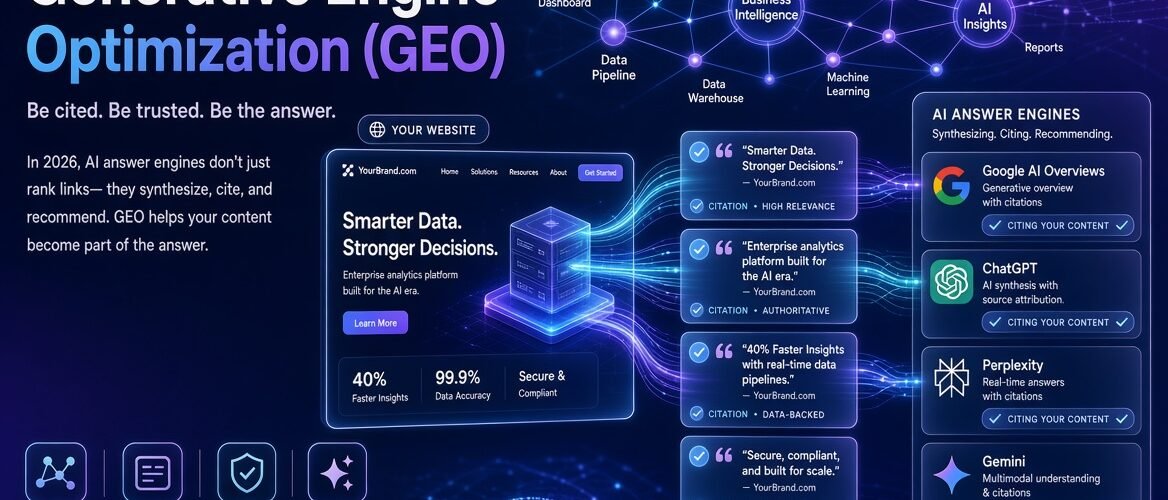
Search is no longer just about ten blue links. In 2026, a growing share of queries never reach a traditional results page at all — they are answered directly by Google AI Overviews, Google AI Mode, ChatGPT, Perplexity, or Gemini. For website owners, bloggers, and marketers, this shift has created a new discipline that industry insiders now call Generative Engine Optimization (GEO).
If your traffic has quietly declined even though your rankings look fine on paper, GEO is almost certainly the reason. This guide breaks down exactly what has changed, why it matters, and the practical steps you can take today to stay visible — whether you’re being read by a human or by an AI model summarizing the web on their behalf.
What Is Generative Engine Optimization (GEO)?
GEO is the practice of optimizing content so that AI-driven answer engines can find it, understand it, trust it, and — most importantly — cite it. Unlike classic SEO, where the goal is a top-10 ranking, GEO’s goal is to become the source an AI system quotes or references when generating an answer.
The core difference comes down to this:
- Traditional SEO optimizes for clicks from a ranked list of links.
- GEO optimizes for citations inside a generated, conversational answer.
Both still matter. But if your content strategy only accounts for the first, you are increasingly invisible in the second — and the second is where user attention is moving.
Why Traditional SEO Alone No Longer Works in 2026
The Click-Through Rate Decline
Multiple independent studies published this year point in the same direction: when an AI Overview appears above the organic results, click-through rates for the top-ranking page fall sharply — some industry analyses report declines north of 30% for the number-one organic position. The exact number varies by industry, query type, and device, but the trend is consistent enough that it can no longer be dismissed as noise.
This doesn’t mean organic search is dying. It means the “easy” informational click — the kind that used to reward a well-optimized how-to page — is becoming scarcer, while commercial and comparison-driven queries still send meaningful traffic.
From Rankings to Citations
Google, ChatGPT, Perplexity, and Gemini all work the same basic way when generating an answer: they retrieve relevant passages from the web, then synthesize a response and attach citations. If your page isn’t retrieved, understood, or trusted enough to be cited, it effectively doesn’t exist in that answer — no matter how well it would have ranked in 2022.
This is why entity clarity, structured data, and first-party evidence now matter as much as keyword placement.
How AI Search Engines Decide What to Cite
Entity Clarity
AI systems need to understand what your page is about and who is behind it without ambiguity. Clear headings, direct definitions near the top of a section, and consistent naming of products, people, and concepts all help a model correctly identify your content as a match for a query.
First-Party Evidence
Generic explainer content — the kind that simply repeats what a hundred other articles already say — is losing visibility. Pages that include original data, first-hand testing, case studies, or expert commentary are far more likely to be treated as a trustworthy source worth citing.
Structured Data and FAQ Schema
Implementing schema markup, particularly FAQPage and HowTo schema, gives AI crawlers an explicit, machine-readable summary of your content. According to Google’s own Search Central documentation, structured data helps search systems understand the content of a page more precisely, which in turn affects how that content can be surfaced and summarized.
Step-by-Step GEO Strategy for 2026
Here is a practical framework you can apply to any existing site.
Step 1: Audit Crawler Access
Before anything else, confirm that AI crawlers can actually reach your content. Check your robots.txt file, verify that critical pages render properly without JavaScript blocking, and make sure your XML sitemap is current. A page that can’t be crawled can’t be cited, no matter how good the content is.
Step 2: Build Evidence-Rich Pages
For every important page, ask: what does this page say that no other page says? Add original statistics, screenshots, short case studies, or a founder/expert’s direct perspective. Google’s own guidance on people-first content — outlined in its Search Essentials documentation — consistently emphasizes originality, expertise, and demonstrated experience over generic summaries.
Step 3: Track Citations, Not Just Traffic
Traditional analytics dashboards were built to measure clicks. In 2026, you also need to track:
- How often your brand is mentioned in AI Overviews or AI Mode answers
- Branded search volume (a strong proxy for AI-driven awareness)
- Assisted conversions that start with an AI-generated recommendation
Step 4: Monitor Visibility With the Right Tools
You don’t need an expensive enterprise stack to start tracking this. A free, all-in-one platform like the 100% Free SEO Tools Hub SEOSTACKHUB gives you access to keyword tracking, technical audits, and visibility checks without a subscription — a practical starting point for solo bloggers and small teams who want GEO-ready data without the enterprise price tag.
Comparison Table: Traditional SEO vs. Generative Engine Optimization
| Factor | Traditional SEO | Generative Engine Optimization |
|---|---|---|
| Primary goal | Rank in top 10 organic results | Get cited inside an AI-generated answer |
| Success metric | Clicks, impressions, position | Citation frequency, brand mentions, assisted conversions |
| Content style | Keyword-optimized, broad coverage | Evidence-rich, entity-clear, directly quotable |
| Structured data | Optional enhancement | Increasingly essential |
| Link building | Volume-focused | Authority and relevance-focused |
Building Authority Through Guest Posting and Backlinks
Even in an AI-driven search landscape, backlinks from relevant, high-authority sites remain one of the strongest trust signals available. Earning links the right way — from real, topically relevant publications rather than link farms — tells both traditional search engines and AI crawlers that other credible sources vouch for your content.
If manual outreach isn’t realistic for your schedule, a curated marketplace such as Buy and Sell High-Authority Guest Posts can help you connect with vetted publishers in your niche, saving the time it normally takes to build these relationships from scratch. As with any link-building tactic, prioritize relevance and editorial quality over sheer volume — a handful of well-placed, contextual links will outperform dozens of low-quality ones.
Staying Updated: Why Following Daily Tech News Matters
GEO and AI search are moving faster than almost any previous shift in the SEO industry. Algorithm updates, new AI Overview formats, and changes to how models like Gemini or ChatGPT retrieve information can happen within weeks of each other. Falling even a month behind can mean missing a structural change that affects your entire visibility strategy.
Making a habit of checking a dedicated source like Daily Tech Review for the latest technology and search updates can help you catch these shifts early, rather than discovering them after your traffic has already dropped.
Common Mistakes to Avoid
- Chasing keyword density instead of clarity. AI models reward clear, direct answers, not repeated phrases.
- Ignoring technical crawlability. A beautifully written page that AI crawlers can’t render is invisible.
- Publishing generic explainers. If your page could have been written by summarizing three other articles, it probably won’t earn a citation.
- Measuring success by rankings alone. Add citation tracking and branded search monitoring to your reporting.
- Neglecting internal linking. Strong internal links, such as our guide on technical SEO fundamentals and content strategy best practices, help both users and AI crawlers understand how your site’s topics connect.
A Practical Example
Consider a SaaS company that historically ranked #1 for “project management software for small teams.” After AI Overviews began appearing for that query, their clicks dropped by roughly a quarter — even though their ranking position didn’t change. Their fix wasn’t to write more content; it was to restructure their existing page with a direct, quotable definition near the top, add a first-party comparison table backed by their own user data, and implement FAQ schema. Within two months, they began appearing as a cited source inside the AI Overview itself, recovering a meaningful share of the lost visibility.
This example illustrates the core lesson of GEO: the goal is no longer just to be findable — it’s to be quotable.
Frequently Asked Questions
Does GEO replace traditional SEO? No. GEO builds on top of solid SEO fundamentals — crawlability, site speed, and relevant content are still required. GEO adds an additional layer focused on citation-worthiness.
Do I need to rewrite my entire website for GEO? Not necessarily. Start with your highest-traffic and highest-intent pages, add structured data, and strengthen the evidence and clarity of those pages first.
How long does it take to see results from GEO efforts? Most site owners report early signals — such as appearing in AI Overview citations — within four to eight weeks of implementing structured data and evidence-rich content, though this varies by niche and competition.
Conclusion
Generative Engine Optimization isn’t a passing trend — it’s the natural evolution of search as AI-generated answers become the default way many users find information. The sites that adapt now, by focusing on entity clarity, original evidence, structured data, and genuine authority building, will be the ones AI systems trust enough to cite for years to come. Start with an honest audit of your top pages, build out your internal linking structure, and use the free and paid resources available to you to stay ahead of a search landscape that is changing faster than ever.